
How can machine learning models learn more effectively from knowledge graphs? While knowledge graphs capture rich relationships between entities, current knowledge graph embedding methods often struggle to fully exploit their structure and semantics. Understanding why this happens is a key step towards more powerful AI-driven insights.
This question is at the heart of our newly launched research project, DORSET, kicked off in collaboration between WU Vienna (Marta, Fajar and Majlinda) and TU Vienna (Katja, Emanuel, Eleonora, Milos, Nader). The project investigates how different characteristics of knowledge graphs (e.g., semantic richness and graph structure) shape the embedding strategies, and how to bridge the gap between knowledge engineering and embedding methods through characteristic-aware benchmarks. By systematically analyzing these factors, we aim to better understand which approaches work best, when, and why.
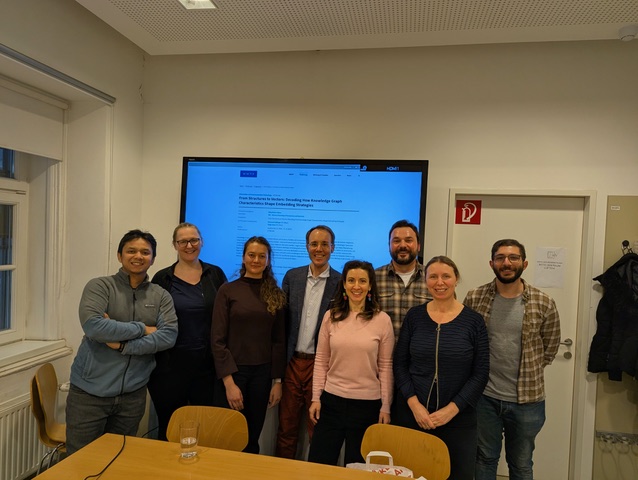
The kickoff meeting aligned all partners on the project vision, expected outcomes, and next steps. We discussed partner expertise, defined the immediate work plan, and set up project management and dissemination activities. With a shared roadmap and strong interdisciplinary collaboration, the project is now officially underway.